
Portfolio direction
Connect experience themes across products so local decisions support a coherent customer journey and business strategy.
Leadership approach
The operating model
The depth of each phase changes with the risk, maturity, and pace of the work. The underlying sequence stays useful across product types.
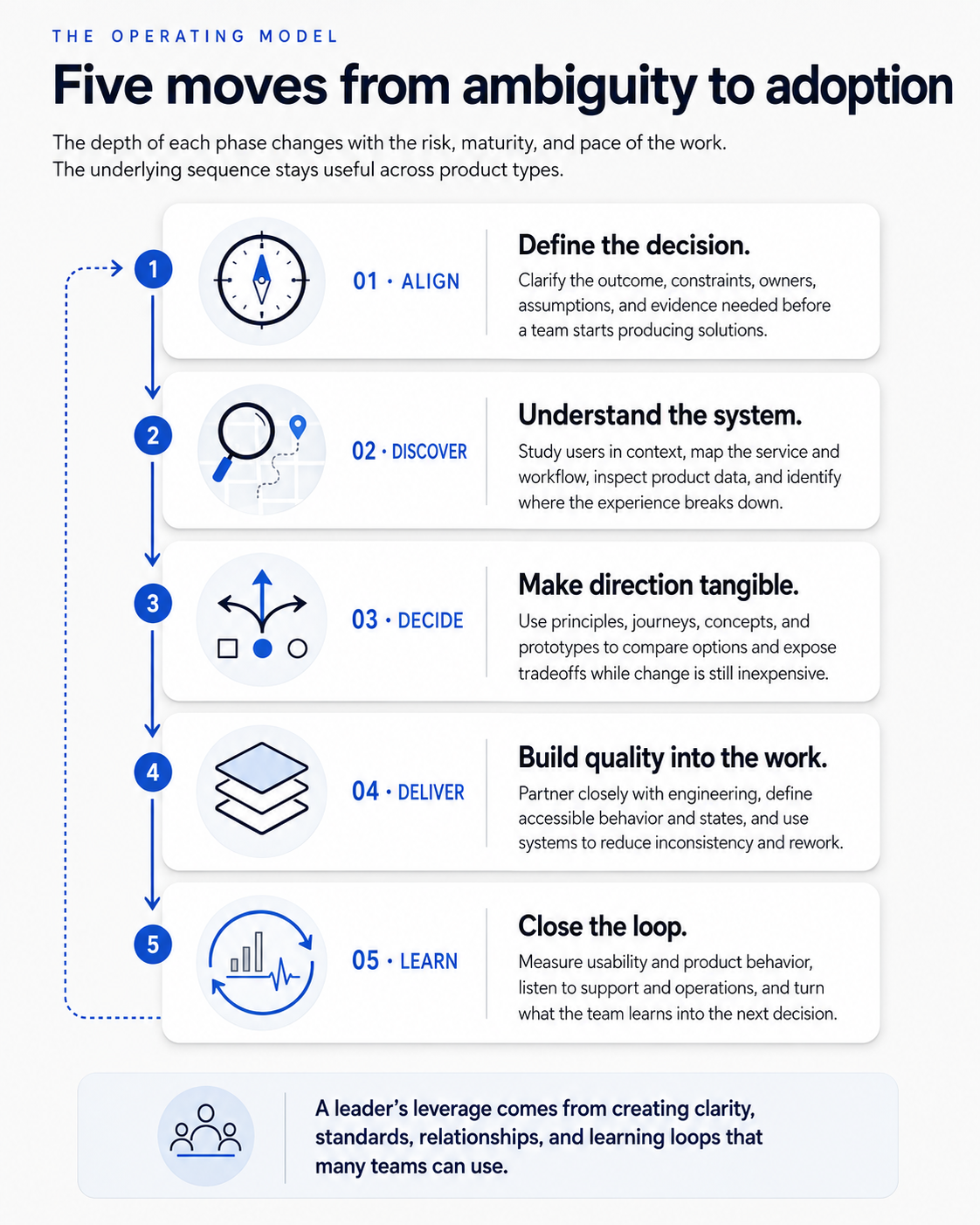
What changes at leadership level
A director’s leverage comes from creating clarity, standards, relationships, and learning loops that many teams can use.
Connect experience themes across products so local decisions support a coherent customer journey and business strategy.
Define what good looks like through principles, accessibility requirements, critique, reviews, and reusable patterns.
Coach judgment, clarify expectations, develop leadership at every level, and create a culture where risks surface early.
Practical artifacts
The deliverables are not the point. They are shared objects that improve the quality and speed of decisions.
Experience vision, outcome framing, principles, journey architecture, opportunity maps, and product narratives.
Research plans, interview synthesis, usability findings, service blueprints, analytics questions, and risk registers.
Design systems, content and accessibility guidance, critique rituals, handoff standards, and quality scorecards.
The case studies show how research findings become concrete product decisions.